
We The (Wave-Sliding) People: Time to Take a Power Stance?
If sustainable surfing is going to mean more than a recycled swing tag and a guilt-soaked tote bag, it probably starts with recognising that surfers have power. In what we buy. Where we spend. How we travel. And, occasionally, what we are prepared to make a bloody nuisance of ourselves about.
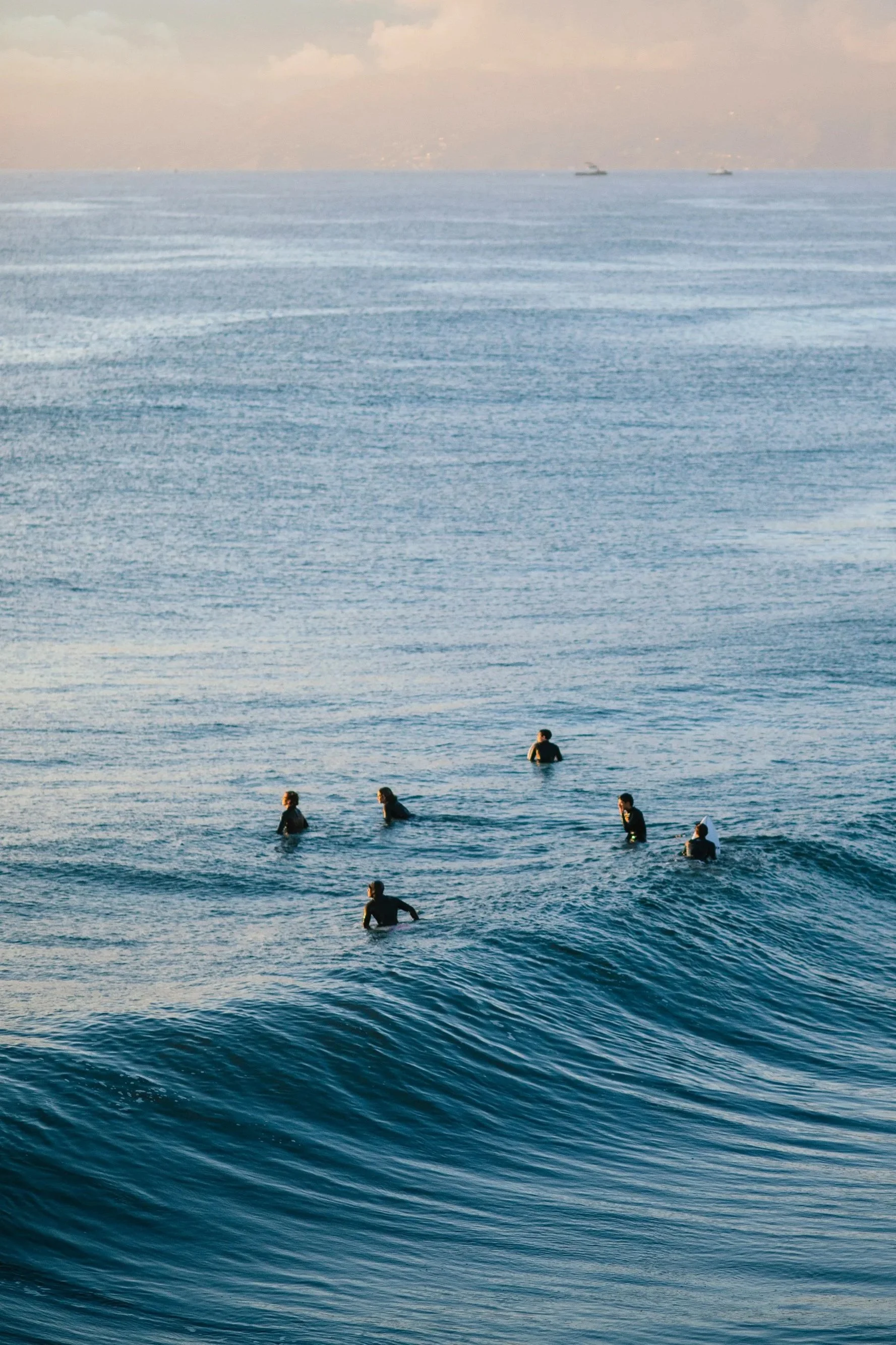
Line-up and be counted.
Chris Hines knows something about this. The co-founder of Surfers Against Sewage recently sat down with C-Skins on the sand at Porthtowan - aka Porthtampon in the bad old days! - to talk about the surf industry’s move from traditional neoprene towards natural-rubber wetsuits. But the conversation goes considerably further than what we wrap around ourselves before paddling out.
Hines’s argument is that surfing punches above its weight. We are not an enormous community, but surf culture travels. Brands borrow it. Advertisers borrow it. Fashion borrows it (LV, anyone?). Entire towns are shaped by it. So when surfers collectively decide that something is no longer acceptable, the ripples can travel rather further than we might imagine.
SURFERS HAVE FORM
Cornwall has already run this experiment. Surfers Against Sewage began in 1990 because a relatively small group of surfers were thoroughly fed up with sharing their local breaks with raw sewage. They organised, campaigned, made noise, turned up at Parliament and became extremely difficult to ignore. The National Maritime Museum Cornwall credits that campaign with helping to deliver a £5.5 billion clean-up.
Worth remembering the next time somebody tells you individuals cannot change anything. The power behind this huge — and continuing — movement came from a relatively small but determined community deciding the same thing was unacceptable and then behaving accordingly.
A line-up became a constituency.
YOUR WALLET HAS A VOTE
The current wetsuit argument is a useful example. Natural rubber is increasingly replacing petroleum-derived neoprene across parts of the surf industry. Hines’s advice is refreshingly practical: understand what your kit is made from, buy better when you next need something, look after what you already own, repair it and pass it on when you are finished with it.
This is not an advert for buying another wetsuit. Quite the opposite. Consumer power becomes rather pointless if the solution to overconsumption is simply purchasing an exciting new collection of sustainable-looking things.
The more interesting idea is that money carries information. Keep buying disposable rubbish and businesses receive one message. Reward durability, better materials, proper local suppliers and companies attempting to do things differently, and they receive another. We’re not naive: profit is necessary. However, treating profit as the only scoreboard is where things start getting stupid.
THE LINE-UP IS BIGGER THAN THE SUM OF ITS PARTS
Surfers also have another useful advantage: we congregate. We paddle out together. Stand around car parks together. Talk complete nonsense about swell period together. Drive halfway across Cornwall because somebody heard the wind might swing offshore at eleven. And somewhere amongst all that, community happens.
You can arrive solo for a few days in Cornwall and very quickly find yourself part of a small temporary crew. But surfing also plugs that crew into something much larger: generations of people connected by a shared activity, a shared coastline and, hopefully, a certain interest in whether the environment they are entering is clean, protected and going to be there for the next generation too.
That connection matters. Surfing does not automatically make anyone an environmentalist — there are plenty of surfers capable of leaving a disposable coffee cup beside an immaculate beach (seen it; blew a gasket) — but spending enough time paying attention to tides, wind, water and weather does make the natural world rather difficult to dismiss as background scenery.
You are in it.
THE SILENT MAJORITY
One of the strongest points in the Hines interview comes from research far beyond surfing. A major study in Nature Climate Change, based on nearly 130,000 people across 125 countries, found that 89% wanted stronger political action on climate change. Yet people consistently underestimated how willing everybody else was to act. Researchers describe this as a form of pluralistic ignorance: lots of people privately want change while mistakenly assuming everybody else is less bothered.
As such, everyone waits for everyone else. Perhaps the supposedly radical position is sometimes not particularly radical at all. It is simply quieter.
That is where communities become useful. Buying differently matters. So does talking about why. Showing up matters. Signing things. Voting. Asking awkward questions. Supporting organisations doing the hard, boring work after the Instagram post disappears.
Assembly does not always need a placard. Sometimes it starts with finding out that the people beside you think so too.
NO HALOS. NO FAIRYTALES.
Peak is not writing this from an emissions-free throne carved from reclaimed driftwood. We are a travel business. People journey to Cornwall. We heat accommodation, run a sauna, wash towels, buy food, move equipment around and use surfboards and wetsuits that had to be manufactured somewhere.
There are contradictions. Pretending otherwise would be greenwashing with nicer typography.
We have described our own approach as Sustainable-ish. Honest by design. Sustainability is not a summit where we eventually plant a Peak flag and announce ourselves finished. It is the mountain: keep climbing, keep looking for the better route and accept that the summit probably moves every time you get closer.
That means local where practical. Less waste. Equipment that lasts. Better materials as they become available. Sharing journeys. Supporting environmental work. Paying people properly. Questioning suppliers. Improving things when we discover a better way.
People. Planet. Profit. All three have to survive the trip.
SO WHAT DOES SUSTAINABLE SURFING ACTUALLY LOOK LIKE?
Probably not perfection. Sustainable surfing is a collection of better decisions: use equipment for longer, repair before replacing, choose lower-impact materials when you genuinely need new kit, travel more thoughtfully, spend with businesses whose behaviour you want to encourage and support the people protecting the places where you surf.
Then do it again.
Chris Hines’s story is useful because it reminds us that the surf community has done this before. Surfers in Cornwall looked at something everybody had apparently decided was normal, concluded that it was completely ridiculous, and refused to shut up about it.
You do not need to declare war on capitalism from a compost toilet to follow the principle. Just refuse the idea that convenience and profit are the only rules available.
Spend differently. Travel differently. Speak up when something is bollocks. Paddle out with people who care about the same stretch of water. Keep climbing the mountain.
We the wave-sliding people might be a relatively small constituency. But history suggests we can make a surprising amount of noise.
© 2026 Peak Boutique Surf Retreat. Words by Samuel Evans